

NEWS
News information
Subcategory:
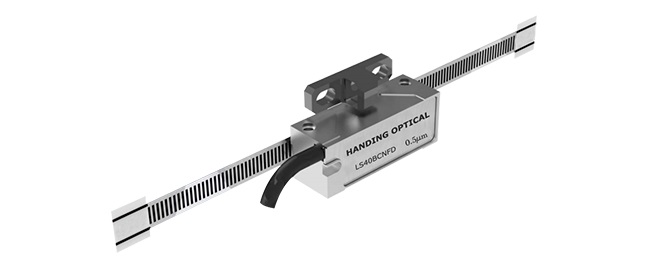
When engineers specify linear encoders for precision motion systems — whether for a vision measuring machine, semiconductor wafer handler, laser cutting system, or coordinate measuring machine — the selection decision involves far more variables than resolution and accuracy specifications alone. At Handing Optical, we supply exposed linear encoders and optical linear scale systems to OEM machine builders across multiple industries, and we regularly support engineering teams through the encoder selection process. This article presents the practical decision framework our applications engineers use when advising customers.
Step 1: Define Your True Accuracy Requirement
The first and most common mistake in encoder selection is conflating measurement resolution with system accuracy. A linear encoder with a signal period of 20 μm and 1000× interpolation will report a resolution of 0.02 μm — but this resolution figure tells you nothing about the actual positional accuracy of the system over its full travel range.
The accuracy of an optical linear encoder system is determined by the quality and manufacturing consistency of the linear scale (grating pitch uniformity), the interpolation quality of the readhead electronics (which affects sub-divisional error, or SDE), and installation factors including alignment, mounting rigidity, and thermal expansion management.
For our optical linear encoders, we specify both a position accuracy figure (typically expressed as ±X μm over a defined travel length) and a sub-divisional error specification that captures the periodic positional error within a single grating pitch cycle. For high-resolution applications, SDE is often the dominant accuracy limitation, not the scale manufacturing tolerance.
Our recommendation: always specify your accuracy requirement in terms of maximum allowable positional error over the full system travel, then work backward to select encoder specifications that deliver this performance with an appropriate margin.
Step 2: Evaluate Environmental Exposure
Exposed linear encoders — also called open linear encoders or open linear scales — offer significant advantages in applications where compactness, low moving mass, and low friction are priorities. Without a housing, they present a minimal profile and add virtually no mass to the moving axis. However, they require a reasonably controlled operating environment.
Our exposed linear encoder product range is designed with contamination resistance as a core design criterion. The readhead uses a large-area scanning aperture that averages signal across multiple grating periods, providing inherent immunity to localized contamination events such as coolant mist, fine metal particles, or optical disturbances. However, for applications involving immersion cooling, high-pressure fluid jets, or abrasive chip generation, an enclosed linear scale with IP67 or higher ingress protection is the appropriate choice.
When evaluating environmental exposure, also consider:
Step 3: Match the Signal Interface to Your Motion Controller
Linear encoders output position signals in one of several standard formats, and selecting the correct output interface for your motion controller is critical for both compatibility and performance.
The most common output formats are:
1-Vpp sine/cosine (analog): This format transmits the raw interpolation signals from the readhead to an external interpolation unit or to a motion controller with on-board interpolation capability. The advantage is that the interpolation factor can be set or changed in the controller, providing flexibility. The limitation is that cable length and signal integrity constraints become more significant at high traversal speeds.
TTL quadrature (digital): A fixed-interpolation digital output in which the readhead produces A, B, and Z (reference mark) square wave signals. This format is universally compatible with standard motion controllers and is the most straightforward to integrate. Resolution is fixed at the time of readhead selection.
BiSS-C / EnDat (serial absolute): For systems requiring absolute position information without a homing routine, absolute encoder variants using serial communication protocols provide position within the full travel range from power-on. Our incremental encoders cover the majority of precision motion applications, but absolute encoder options are available for specific requirements.
Step 4: Plan Your Reference Mark Strategy
All of our incremental linear encoders include a reference mark (index pulse) in the scale. On power-up or following an emergency stop, a controlled homing routine traverses the axis to find this reference mark, establishing a known absolute position within the incremental measurement framework.
For applications where homing traverse time is a concern, we offer scales with multiple reference marks at defined intervals, allowing homing to complete within a short traverse regardless of the axis start position. For applications where any homing movement is impractical, absolute encoder variants eliminate this requirement entirely.
Practical Support from Our Applications Team
Encoder selection is rarely a purely catalog exercise. Installation details — readhead mounting bracket design, cable routing, connector selection — often have a larger practical impact on system performance than the encoder specifications themselves. Our technical team provides installation guidelines and, for OEM machine builder customers, we support first-article installation review to verify alignment and signal quality before volume production begins.
We also offer compatibility guidance for customers integrating our optical linear encoders into vision measuring machines (VMM), video measuring systems, and non-contact measuring machines where encoder performance directly determines measurement system accuracy.
To discuss your application requirements, contact us at handing3d@163.com — our engineering team will respond with specific product recommendations and technical documentation to support your qualification process.
Han Ding offers a one-stop service from needs analysis, product solutions, usage guidance, to after-sales tracking

Address:No. 98, Zhen'an East Road, Chang'an Town, Dongguan City, Guangdong Province, China
Mobile:+86-130 3887 8595 / Aico Ding
Email:handing3d@163.com